Navigated to Jesse Schell Speaks with Only Single Player at PAX West

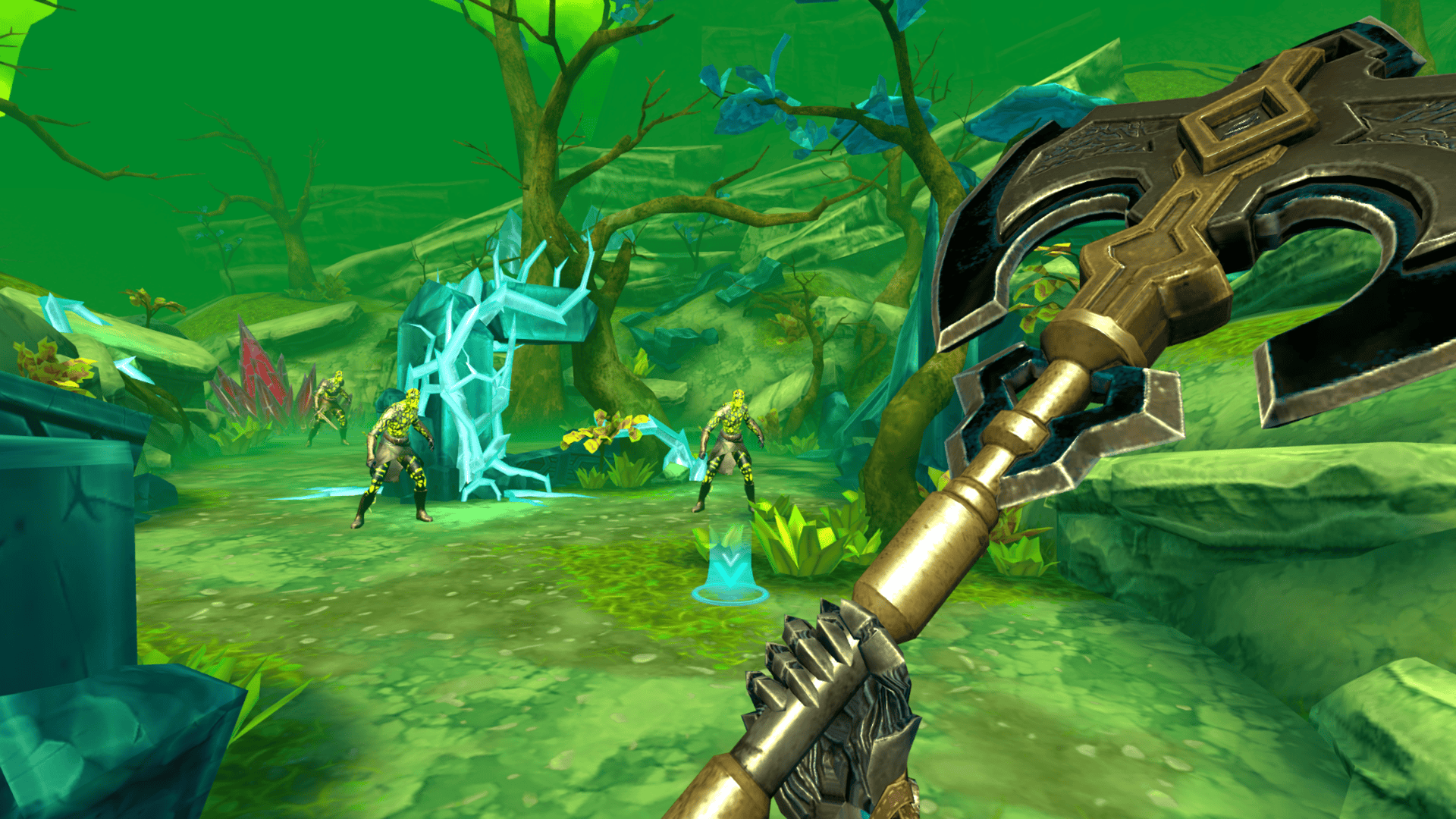
![Until You Fall screenshot showing the player with an ax about to engage enemies]()
![Until You Fall screenshot showing an enemy wielding a sword about the attack the player]()
- (1) Thacharodi, A., Singh, P., Meenatchi, R., Tawfeeq Ahmed, Z. H., Kumar, R. R., V, N., ... & Hassan, S. (2024). Revolutionizing healthcare and medicine: The impact of modern technologies for a healthier future—A comprehensive review. Health Care Science, 3, 329-349.
- (2) Giakoni-Ramírez, F., Godoy-Cumillaf, A., Espoz-Lazo, S., Duclos-Bastias, D., & del Val Martín, P. (2023). Physical activity in immersive virtual reality: A scoping review. Healthcare (Basel), 11, 1553.
- (3) Hunter, T. (2022, April 21). Let’s get Meta-physical: Why Oculus fitness actually works. The Washington Post.
- (4) Virtual Reality Institute of Health and Exercise. (2022, April 13). Until you fall.
- (5) Moffitt, R. L. (2024). A psychosocial investigation of exercise preferences in real and virtual environments. Psychology of Sport and Exercise, 70, 102530.
- (6) Kyu, H. H., Bachman, V. F., Alexander, L. T. Mumford, J. E., … & Forouzanfar, M. H. (2016). Physical activity and risk of breast cancer, colon cancer, diabetes, ischemic heart disease, and ischemic stroke events: Systematic review and dose-response meta-analysis for the Global Burden of Disease Study 2013. BMJ, 354, i3857.
- (7) Rebar, A. L., Stanton, R., Geard, D., Short, C., Duncan, M. J., & Vandelanotte, C. (2015). A meta-meta-analysis of the effect of physical activity on depression and anxiety in non-clinical adult populations. Health Psychology Review, 9, 366-378.
- (8) Ulas, K., & Semin, I. (2020). The Biological and motivational effects of aerobic exercise with virtual reality. Research Quarterly for Exercise and Sport, 92, 321–326.
- (9) Nystoriak, M. A., & Bhatnagar, A. (2018). Cardiovascular effects and benefits of exercise. Frontiers in Cardiovascular Medicine, 5. https://doi.org/10.3389/fcvm.2018.00135
- (10) Pedersen, B. K., & Saltin, B. (2015). Exercise as medicine – Evidence for prescribing exercise as therapy in 26 different chronic diseases. Scandinavian Journal of Medicine & Science in Sports, 25, 1-72.
- (11) Lo, H. H. M., Ng, M., Fong, P. Y. H., Lai, H. H. K., Wang, B., …, & Sit, R. W. S. (2024). Examining the feasibility, acceptability, and preliminary efficacy of an immersive virtual reality–assisted lower limb strength training for knee osteoarthritis: Mixed methods pilot randomized controlled trial. JMIR Serious Games, 12, e52563.
- (12) Fyfe, J. J., Hamilton, D. L., & Daly, R. M. (2022). Minimal-dose resistance training for improving muscle mass, strength, and function: A narrative review of current evidence and practical considerations. Sports Medicine, 52, 463-479.
- (13) Rutkowski, S., Adamczyk, M., Pastuła, A., Gos, E., Luque-Moreno, C., & Rutkowska, A. (2021). Training using a commercial immersive virtual reality system on hand–eye coordination and reaction time in young musicians: A pilot study. International Journal of Environmental Research and Public Health, 18, 1297.
- (14) Vaeyens, R., Lenoir, M., Williams, A. M., & Philippaerts, R. M. (2008). Talent identification and development programmes in sport: Current models and future directions. Sports Medicine, 37, 703-714.
- (15) Navarro, J., Hernout, E., Osiurak, F., & Reynaud, E. (2020). On the nature of eye-hand coordination in natural steering behavior. PloS one, 15, e0242818.
- (16) Corbetta, D., Imeri, F., & Gatti, R. (2015). Rehabilitation that incorporates virtual reality is more effective than standard rehabilitation for improving walking speed, balance and mobility after stroke: A systematic review. Journal of Physiotherapy, 61, 117-124.
- (17) Sherrington, C., Fairhall, N. J., Wallbank, G. K., Tiedemann, A., Michaleff, Z. A., … & Lamb, S. E. (2019). Exercise for preventing falls in older people living in the community. Cochrane Database of Systematic Reviews.
- (18) Goble, D. J. (2014). Proprioceptive acuity assessment via joint position matching: From basic science to general practice. Physical Therapy & Rehabilitation Journal, 90, 1176-1184.
- (19) Pallavicini, F., & Pepe, A. (2020). Virtual reality games and the role of body involvement in enhancing positive emotions and decreasing anxiety: Within-subjects pilot study. JMIR Serious Games, 8(2), e15635.
- (20) Warburton, D. E. R., Nicol, C. W., & Bredin, S. S. D. (2006). Health benefits of physical activity: The evidence. Canadian Medical Association Journal, 174, 801-809.
- (21) Schuch, F. B., Vancampfort, D., Firth, J., Rosenbaum, S., Ward, P. B., … & Stubbs, B. (2018). Physical activity and incident depression: A meta-analysis of prospective cohort studies. American Journal of Psychiatry, 175, 631-648.
- (22) Anderson, E., & Shivakumar, G. (2013). Effects of exercise and physical activity on anxiety. Frontiers in Psychiatry, 4, 27.
Until You Fall, a neon-fantasy VR sword-fighter by Schell Games, is highlighted by Dr. Brooke Morrill as a revolutionary "exergame" that bridges the gap between gaming and professional health interventions. The experience requires full-body movements—including dodging, squatting, and arm-swinging—that provide a metabolic workout equivalent to playing tennis (6-8 kcal per minute). Research indicates that the game’s immersive mechanics improve cardiovascular health, muscle engagement, and hand-eye coordination through precise motor synchronization. Furthermore, the game challenges proprioception and stability, offering a "desirable difficulty" that enhances balance and mental well-being through endorphin release, making it a viable alternative to traditional physical therapy and resistance training.
- Schell Games
- Dr. Brooke Morrill
- VR Institute of Health and Exercise
- exergame
- functional fitness
- neon-fantasy world
- immersive technology in healthcare
- metabolic equivalent (MET)
- rehabilitation via VR
- proprioception
- muscle hypertrophy (arms/core/legs)
- hypertension management
- anxiety reduction
- How does the physical intensity of Until You Fall compare to traditional sports?
- According to the Virtual Reality Institute of Health and Exercise, playing Until You Fall is equivalent to a game of tennis, burning approximately 6-8 calories per minute. It qualifies as a high-intensity aerobic activity that elevates heart rate and blood flow.
- What muscle groups are primarily engaged during gameplay?
- The game’s sword-fighting mechanics require a combination of defensive stances and offensive strikes, engaging the arms, shoulders, legs, and core. The movements mimic real-world resistance training, helping to improve functional fitness and joint health.
- Can Until You Fall help with balance and coordination?
- Yes. The game requires players to manage their equilibrium during intense action sequences, which enhances proprioception (the sense of body position). Studies show that VR training significantly improves hand-eye coordination by synchronizing visual inputs with physical reactions.
- What are the mental health benefits of this VR experience?
- Beyond physical fitness, the immersive nature of the game promotes the release of endorphins, which can help reduce symptoms of anxiety and depression. The "game-like" nature of the activity also increases long-term motivation compared to traditional, repetitive exercise.
- Is Until You Fall suitable for rehabilitation?
- The brief notes that VR-based training programs have been shown to enhance stability and balance in rehabilitation settings. Because the game is a "low-impact" way to engage in high-intensity movement, it can be a compelling path for those who find traditional exercise less accessible.