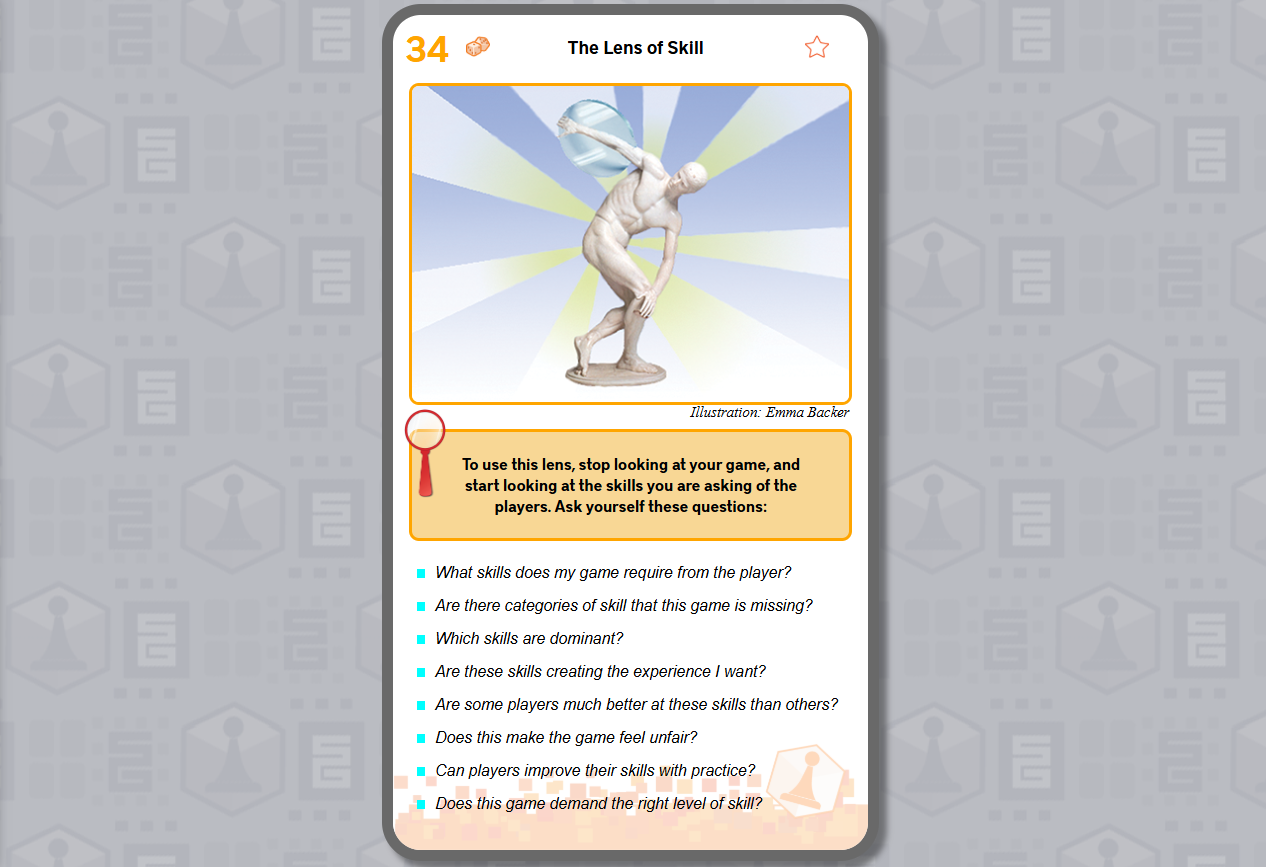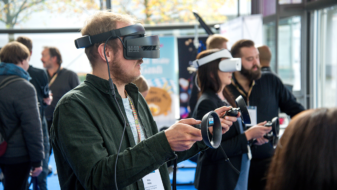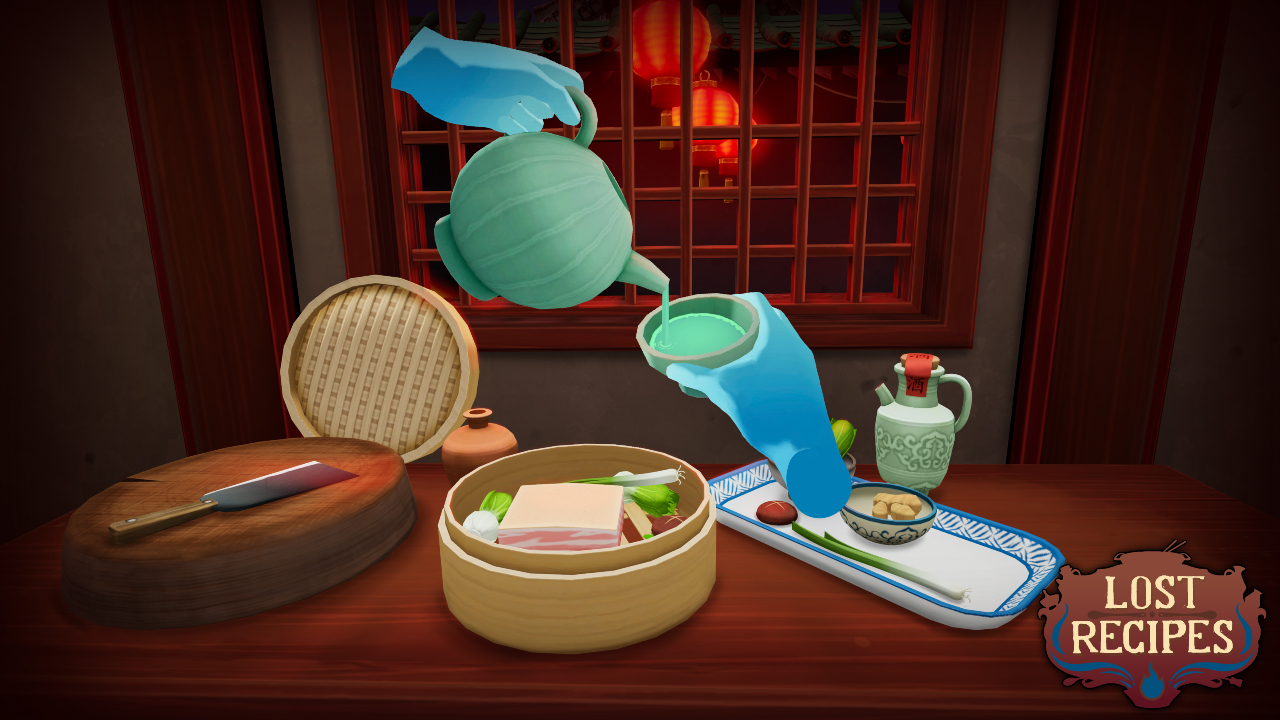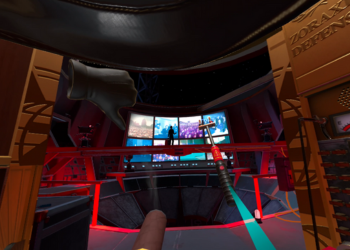
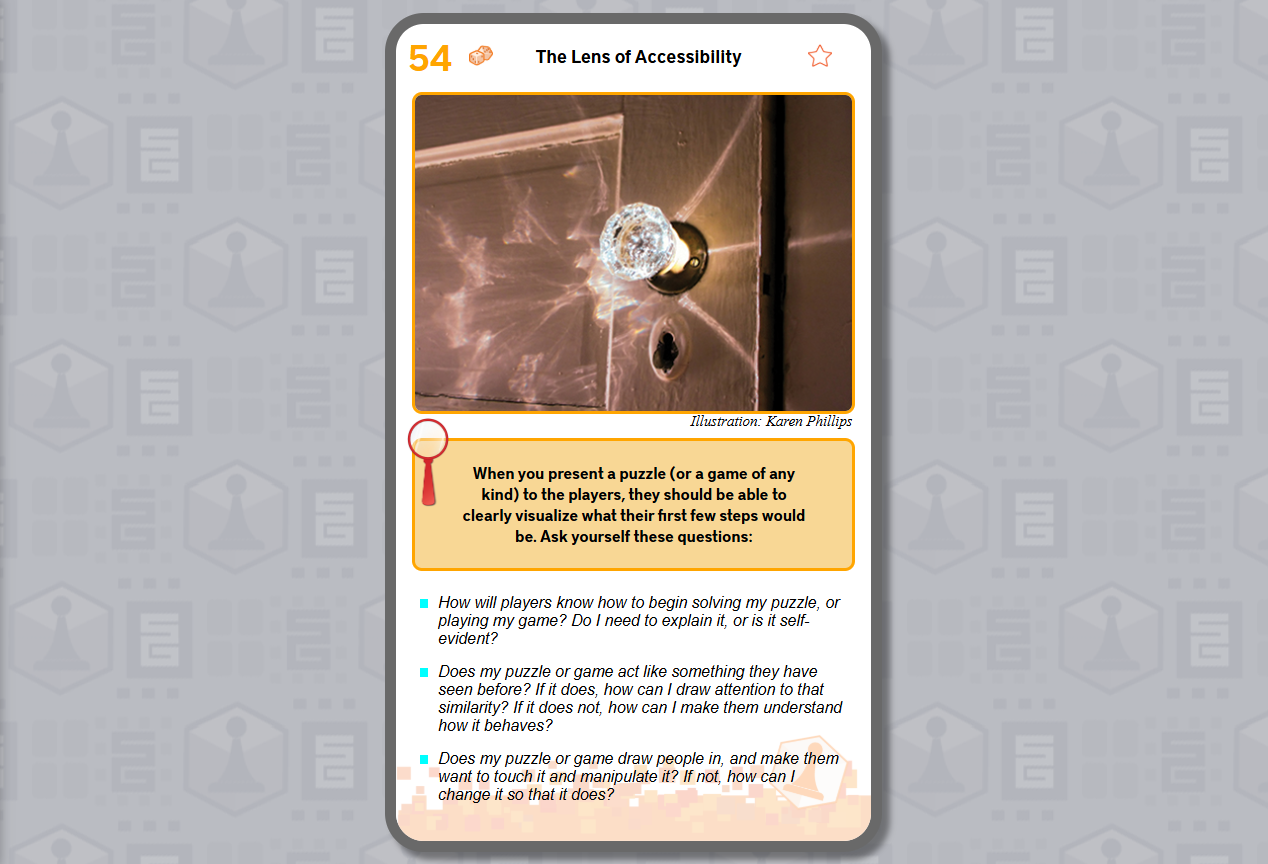
[{"content":{"text":"An increasing number of people are becoming interested in playing video games and many games are being used for other purposes than entertainment, such as education, rehabilitation, and exercise. Because of this, game accessibility has become even more important. Around 92% of people with impairments play games<\/a> despite difficulties. People with impairments not only play games but do so at a regular and frequent rate, averaging at 10.3 hours played per week<\/a>.<\/p>Schell Games strives to reduce the number of difficulties experienced by players with impairments. We have a monthly meeting open to all employees to discuss our accessibility efforts and brainstorm ideas for addressing new accessibility challenges we come across. This Accessibility Committee and their Accessibility Checklist have helped our games become even more inclusive.<\/p>In this blog post, we\u2019ll go over the criteria from three of ten accessibility families: comfort, mobility, and cognitive.<\/p>"},"id":"c316f75e-b928-4460-b11e-caf1dbefb7cf","isHidden":false,"type":"textBlock"},{"content":{"level":"h2","text":"Comfort","customid":""},"id":"cabc549d-5c86-4a52-90d1-35d93031d688","isHidden":false,"type":"headingBlock"},{"content":{"location":"kirby","image":["file:\/\/klmet0cxj5i7wtzm"],"src":"","alt":"Screenshot of a door with a crystal doorknob reflecting lights for the Lens of Accessbility","caption":"The Lens of Accessibility from \"The Art of Game Design\" Deck of Lenses.","link":"","ratio":"","crop":"false"},"id":"5691223a-52ad-4806-bc57-17918cf3c355","isHidden":false,"type":"imageBlock"},{"content":{"text":"We define comfort as \u201cbodily and mental comfort, including issues like simulation sickness, sensory overload, etc.\u201d The player experience should be enjoyable! To accommodate this accessibility family, we have several checklist items that tackle each issue individually: sensory overload, motion sickness, and content comfort. Included below is a list of some criteria we aim to meet when we design and develop games:<\/p>"},"id":"d412e0f7-3a3b-4b29-8cfc-9b3ab9d6a876","isHidden":false,"type":"textBlock"},{"content":{"text":"If a game is in virtual reality (VR), it\u2019s important to include systems to support reducing simulation sickness during continuous locomotion (e.g. vignetting) or mechanics to bypass locomotion (e.g. teleportation)<\/li>The game allows adjustment of the relative volume of audio (vo, sfx, music, etc.)<\/li>If the game contains mature content, the game clearly telegraphs the inclusion of any mature content or difficult themes upfront<\/li><\/ul>"},"id":"b4db1cd8-27ac-4d5f-af22-5ec9e7ce5f83","isHidden":false,"type":"listBlock"},{"content":{"level":"h2","text":"Cognitive","customid":""},"id":"9b6543e2-821e-463e-a513-d8ad53362bfc","isHidden":false,"type":"headingBlock"},{"content":{"location":"kirby","image":["file:\/\/13nnbqvjobcdmywy"],"src":"","alt":"Screenshot of a Greek-inspired statue holding a glass lens, preparing to throw it like a discus, as an illustration for the Lens of Skill","caption":"The Lens of Skill from \"The Art of Game Design\" Deck of Lenses.","link":"","ratio":"","crop":"false"},"id":"4ff5360d-836e-471c-b4e5-6166a3c4ddd4","isHidden":false,"type":"imageBlock"},{"content":{"text":"We define cognitive as \u201cissues related to memory, comprehension, skill, and attention.\u201d Here are some additional cognitive criteria we aim for:<\/p>"},"id":"6e6b2a9b-17df-48bf-8bf9-c7b357331dd4","isHidden":false,"type":"textBlock"},{"content":{"text":"The game's difficulty can be adjusted<\/li>The game includes tutorials<\/li>The game includes a way to practice without failure, such as a practice level or sandbox mode<\/li>The game provides reminders about current objectives during game<\/li><\/ul>"},"id":"ed7d0654-45f5-4257-8f0f-e578fbb4eb53","isHidden":false,"type":"listBlock"},{"content":{"level":"h2","text":"Mobility","customid":""},"id":"1697d4e4-5cd1-49d0-8a3c-32fb1d44b85e","isHidden":false,"type":"headingBlock"},{"content":{"text":"After making I Expect You To Die<\/em> <\/a>and Until <\/em><\/a>You<\/em><\/a> Fall<\/em><\/a>, two VR titles, we have learned a lot about making mobility accessible in games. Mobility is defined by our studio as \u201cissues related standing\/sitting, movement, handedness, control dexterity, height, etc.\u201d Additionally, we consider factors like the below as we develop games:<\/p>"},"id":"bb66c538-f5e9-43ee-98a0-530a4e36bb2d","isHidden":false,"type":"textBlock"},{"content":{"text":"If using VR\/AR or physical space, the game provides adjustments to the height of important objects to accommodate players of differing heights<\/li>The game can comfortably accommodate both left-handed or right-handed players (consider controls, UI, and game-world layout)<\/li>The game can accommodate players being seated in a chair or wheelchair<\/li>If in VR, the game does not require players to carry objects in both hands<\/li><\/ul>"},"id":"2dea0ad2-90f5-4a9b-a038-1b1ecea9ee74","isHidden":false,"type":"listBlock"},{"content":{"location":"","url":"https:\/\/youtu.be\/pH2-UMRWLY8","video":[],"poster":[],"caption":"","autoplay":"false","muted":"true","loop":"false","controls":"true","preload":""},"id":"c3b00417-911d-4c1c-9506-a77a2aeb30c4","isHidden":false,"type":"videoBlock"},{"content":{"level":"h2","text":"More on Accessibility at Schell Games","customid":""},"id":"5170aaa5-00f8-4866-9cda-0e704bed656c","isHidden":false,"type":"headingBlock"},{"content":{"text":"Our dedication to accessibility doesn't stop there! If you'd like to learn more about how we accommodate players, check out our interviews with GameSkinny<\/a>, GameTyrant<\/a>, and GamingBolt<\/a>.<\/p>You can also watch our Dinner w\/ the Devs about accessibility<\/a>.<\/p>"},"id":"63f7636b-1813-42b2-aa82-1f5af2a961fe","isHidden":false,"type":"textBlock"}]