![]()
![]()
- History: This is all about backstory. No good character is born the day the story takes place. Usually, there is a full and interesting life that took place before the player ever meets that character. You need to know how full it is and why it’s interesting. To be clear, the most interesting part is yet to come. We have a story to tell after all. But if you know how many years Betty spent in the Air Force and how many kids Linda has at home, it’s going to create organic interactions later.
- Strengths: Everyone is good at something. Sometimes a person is good at a lot of things. Sometimes a person just makes a mean roast beef panini. Or maybe they’re very good at being a very big pain in the neck. Whatever it is, you need to know. The Day Shift characters had the advantage of being career-focused for the purposes of the game. That gave us a solid ground to stand on as it pertains to strengths and weaknesses.
- Weakness: Likewise, everyone is bad at something. I’m not talking an aversion to kryptonite here. I’m talking about how our surgeon, Charles, simply can’t smalltalk to save his life. Aleja has no patience when it comes to kids. Benny has a really hard time inserting catheters. Knowing weaknesses allows you to play with those weaknesses to create dramatic conflict.
- Relationships: No one exists in a vacuum, especially not a group of people working together in an emergency department. Knowing whom a character calls friend and enemy speaks volumes about them. These relationships are what fuel our conflicts and create our tension. Drama requires two or more opposing forces. Establishing character relationships is all about informing those forces.
- Wants: Everyone wants something. If a character doesn’t want something, there is really no reason for a story to be told about them. Maybe our nurse wants a promotion. Maybe a surgeon really wants to be seen as a hero to a family. Maybe an administrator wants to be seen as “one of the girls” instead of the boss. Whatever it is, knowing the “wants” will inform how characters act.
- Change: If you ask me, there is no story without character change. If a character does not emerge from a conflict having changed in some way, there is no meaning to that conflict. Even in a game where the characters are meant to be founts of career defining information, they still need to explore, discover, and change.
![]()
![]()
![]()
![]()
- Our characters needed to be fun AND informative. At Schell Games, we place great importance on a fun-first approach. Creating characters that were lively and had immediate “curb appeal” was a priority. It may not get us the relatability by itself but larger-than-life exaggerated personalities are easily approachable.
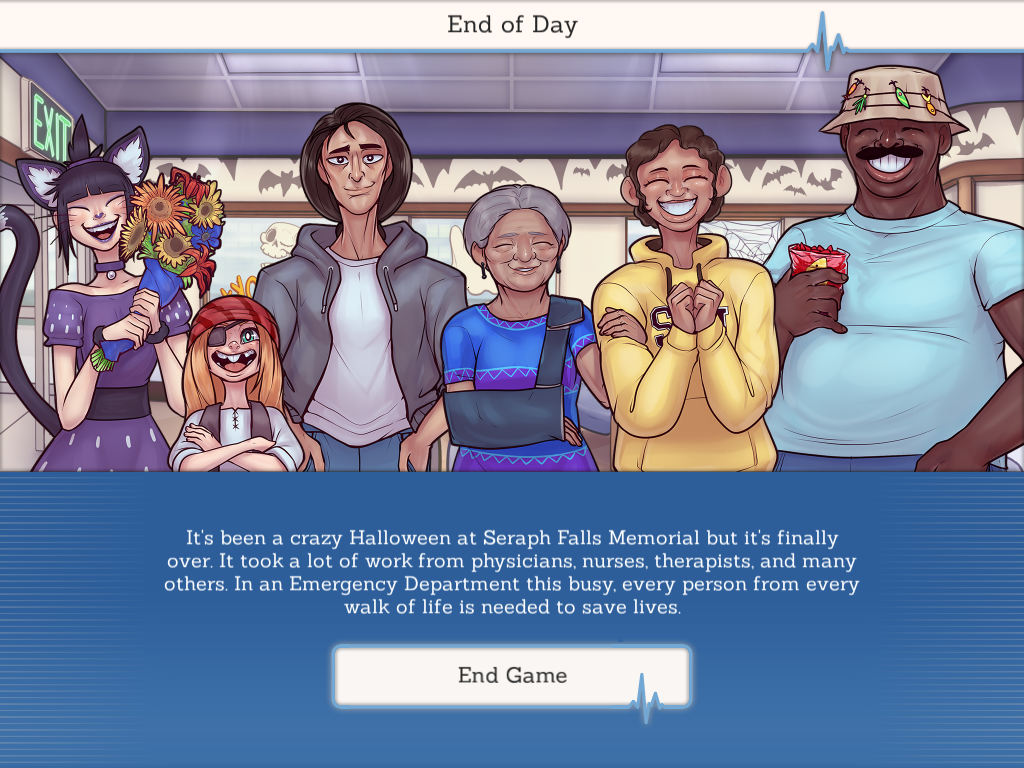
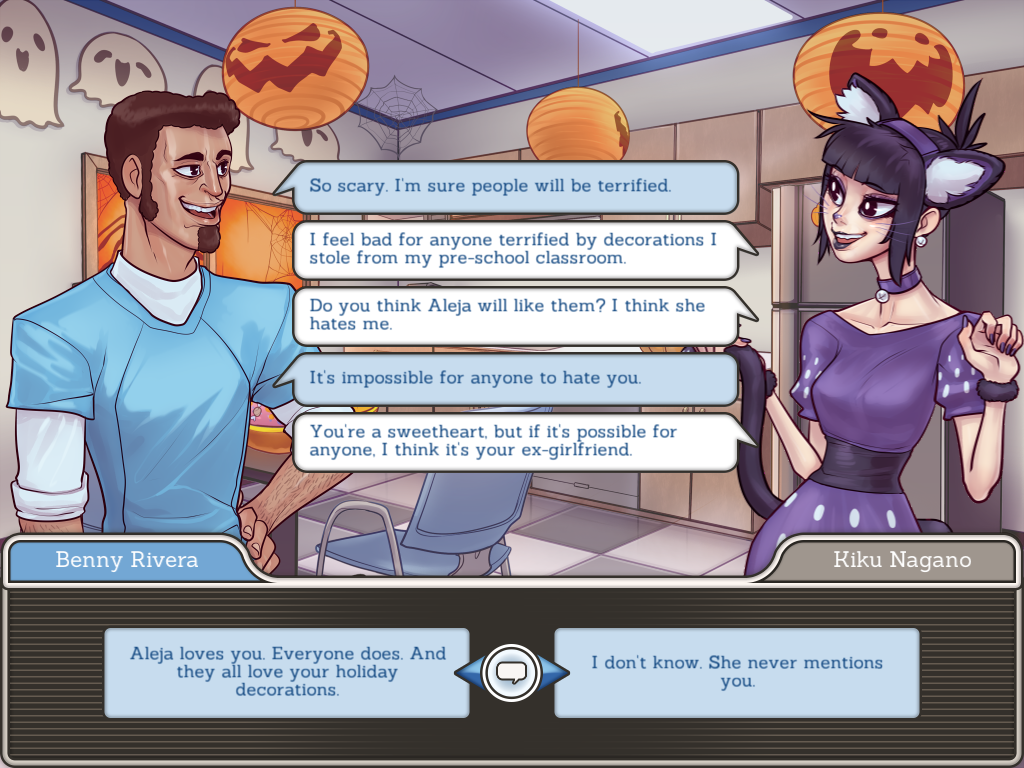
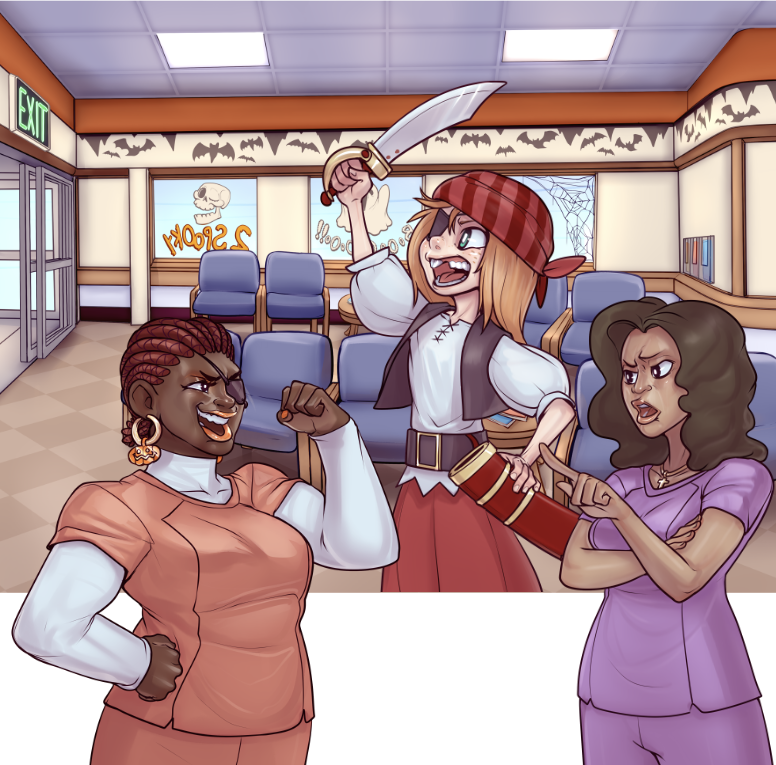
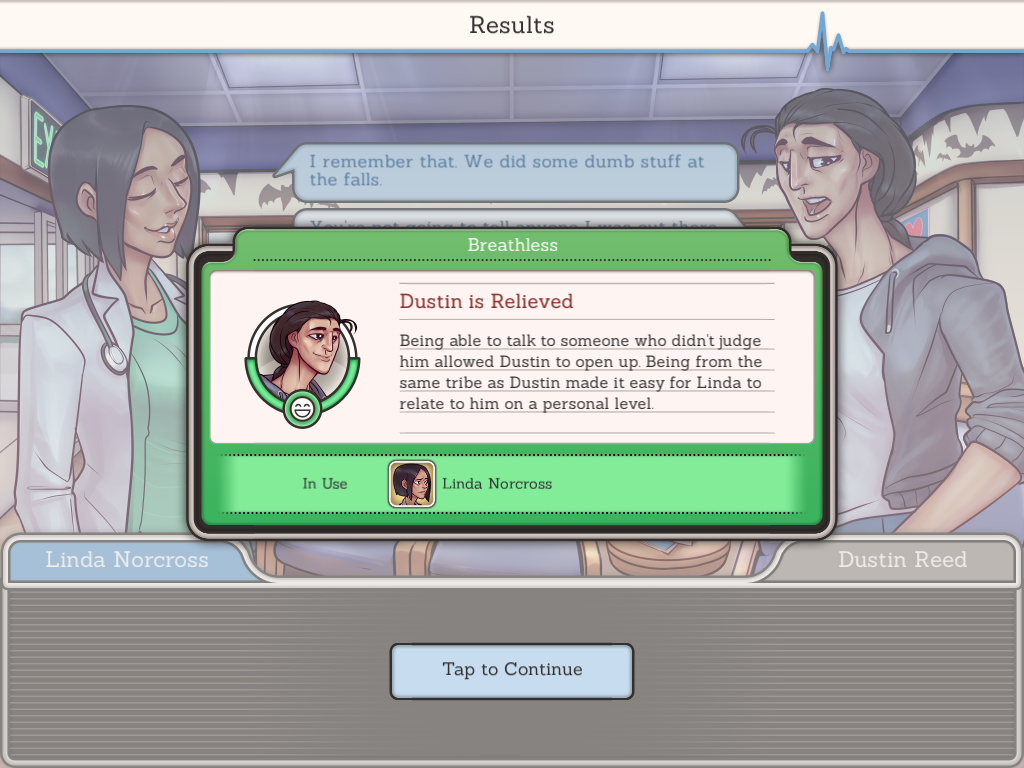
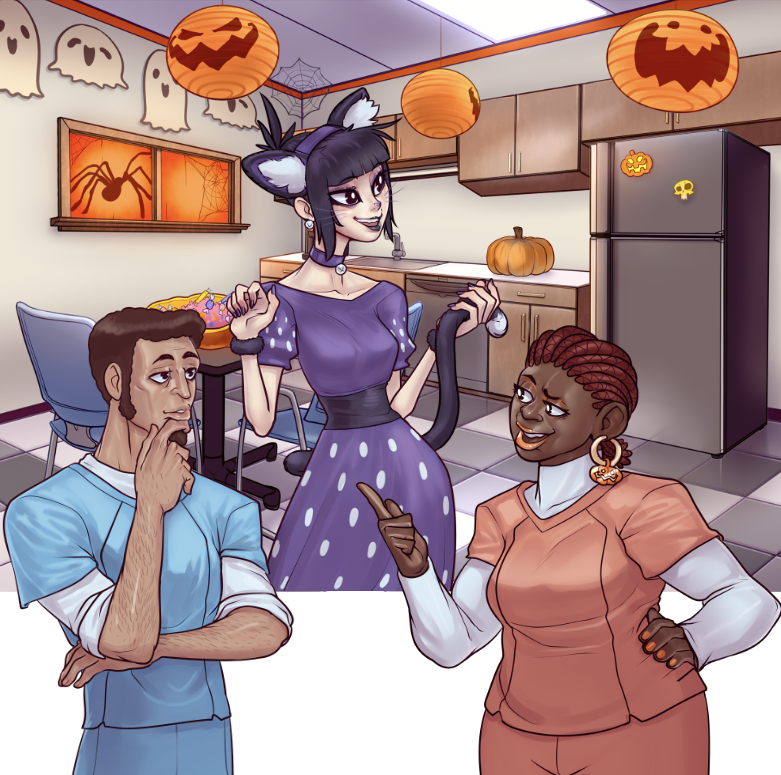
- We needed to emphasize one archetypal trait. We didn’t have a lot of space to get players interested in these characters so we tried to play up a single appealing trait. Katie only talks like a pirate. Dustin is so insecure, he can’t look people in the eyes. Kiku has an abundance of Halloween spirit. They don’t need to be positive traits. They need to be something players can latch onto and say, “Oh yeah, Dustin was that dude who apologized all the time.”
- We needed to stay away from preaching. In an information-centric game, sometimes you can come off as trying too hard to teach a lesson. We don’t want our characters to be teachers, we want them to be representations of what players may someday become. So we stayed away from telling players to stop eating cheeseburgers and exercise daily, even though these are things you may find in a games focused on healthcare.
- We needed to pay attention to character voice. This is a given but it’s worth calling out. Betty calls everyone “honey.” Dustin’s dialogue uses a lot of ellipses to show he isn’t confident. Charles does not use contractions. Benny sneaks sarcasm into everything he says. It’s these quirks that portray a vivid personality. We had to be careful though. They’re only vivid if players can associate with them personally. If they don’t know anyone sarcastic in real life, they have a harder time relating to that personality.
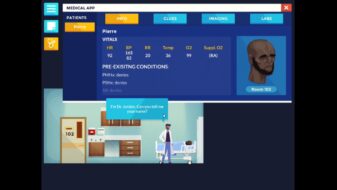
The article breaks down the development of Day Shift, an interactive, branching-dialogue RPG engineered to inspire middle school students to explore careers in emergency medicine. To ensure the game followed a "fun-first" design philosophy rather than coming across as dry or preachy, the team focused heavily on character relatability and curb appeal. The author introduces the studio's HSWRWC framework (History, Strengths, Weaknesses, Relationships, Wants, and Change) as the structural foundation for writing compelling, three-dimensional personas. To bridge the age gap between adult medical professionals and a young adult demographic, the team resisted a post-apocalyptic "teen-run wasteland" trope in favor of grounding the characters in real-world professions while heightening their entertainment value using distinct voice quirks, exaggerated archetypal flaws, and an explicit avoiding of moral lecturing.
- Young Adult (YA) fiction structures
- internal focus
- relatability vs. obfuscation
- Scripted voice quirks
- contraction exclusion
- ellipsis-driven cadence tracking
- Transformational games
- information delivery without preaching
- workforce pipeline inspiration
- Why did the development team reject the scrapped "Post-Apocalyptic Wasteland" concept?
- When trying to figure out how to make adult medical characters relatable to a middle school demographic, the team initially pitched a story where teens ran a hospital in an adult-free wasteland. While highly relatable for a Young Adult (YA) audience accustomed to rebellion themes, it was rejected because it failed the game's core pedagogical mission: familiarizing students with a modern, positive emergency department layout and accurate career pipelines.
- How did the writers capture the attention of a young adult audience when dealing with older characters?
- Middle schoolers are internally focused and exploring their own identities. To make older characters instantly approachable, the studio leaned into high curb appeal and explicit motivations. If a character's desires (wants) are obfuscated, teens will lose interest. By explicitly playing up a single exaggerated archetypal trait (such as a character who is intensely insecure or another who has an obsessive amount of Halloween spirit), the characters became instantly memorable.
- What specific dialogue techniques were used to give the medical staff distinct "voices"?
- The writers carefully tailored the text formatting and syntax to establish vivid personalities without relying on expensive graphics:Charles (The Surgeon): His script entirely banishes the use of contractions to portray an algorithmic, rigid demeanor.Dustin: His dialogue lines are packed with heavy ellipses ($\dots$) to visually communicate his paralyzing lack of confidence.Benny: His text options sneak layered sarcasm into standard medical directives.Betty: She routinely applies localized terms of endearment like "honey" to soften her clinical commands.
- How does Day Shift handle healthcare information delivery without alienating the player?
- The studio followed a strict anti-preaching mandate. In many healthcare-focused educational games, characters break immersion to lecture the player on lifestyle choices (e.g., dieting or exercising). Day Shift avoided this by keeping the characters focused on their professional duties, acting as aspirational representations of what the players could someday become rather than moralistic teachers.