Navigated to The 15 Best Gifts for Gamers in 2022

Schell Games: Your Puzzle Experts

January 28, 2026 · insights

Figure 16.3 from The Art of Game Design showing an interest curve over time with peaks at the beginning and end of the experience

  • Experience is King: The most fundamental tenet is that a game is not its code, its rules, or its art. A game is the experience it creates in the player's mind. This requires a deep understanding of human psychology, emotion, and motivation.  
  • The Elemental Tetrad: Every game is a harmony of four essential elements: Mechanics (the rules), Story (the narrative), Aesthetics (how it looks and sounds), and Technology (the medium). A great game balances all four, ensuring they support a single, unified experience.  
  • Iterative Design: Known as the "Rule of the Loop," this principle states that good games are not designed, they are discovered through a relentless cycle of prototyping, testing, and refinement. This connects directly back to the real-time feedback of Schell's street performance days.

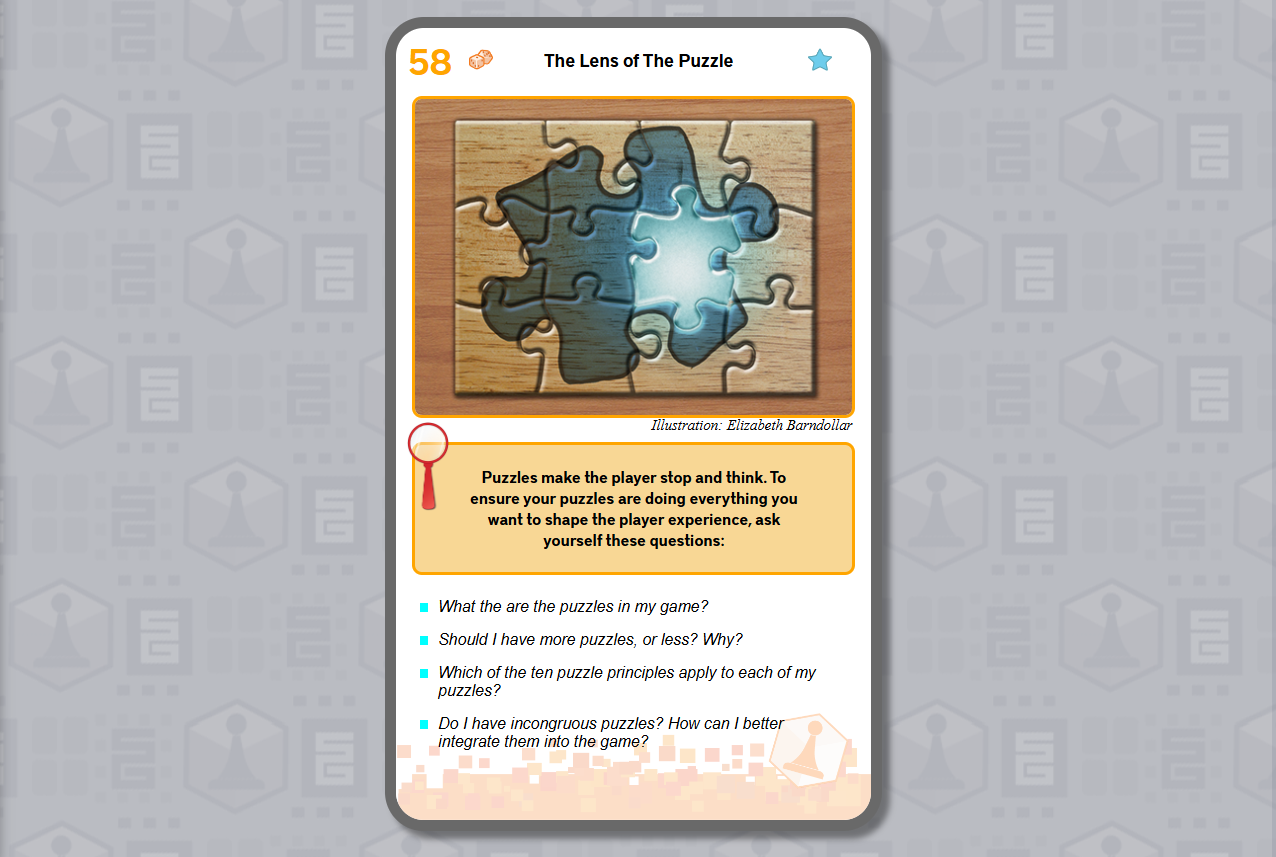
  • Lens 58: The Lens of The Puzzle: This is the heart of the matter. It asks designers to question the purpose and integration of their puzzles: What are the puzzles in my game? Should I have more or less? Are they incongruous with the rest of the experience?. Schell offers a specific definition: "A puzzle is a game with a dominant strategy". This might seem counterintuitively restrictive, but it's actually liberating. It reframes the designer's job: it's not to create an unsolvable enigma, but to craft an elegant, clear path to a solution. The "fun" isn't in banging your head against a wall; it's in the joy of discovering that well-designed path.  
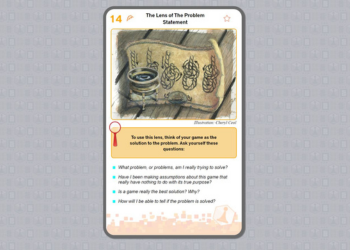
  • Lens 6: The Lens of Problem Solving & Lens 12: The Lens of the Problem Statement: These lenses force a designer to define what problem the player is trying to solve within the game, and, on a meta-level, what problem the designer is trying to solve by creating the game in the first place. This is the foundation of the studio's "transformational games."  
  • Lens 4: The Lens of Curiosity & Lens 23: The Lens of Goals: These two lenses are the engine of a great puzzle. A puzzle must present a clear, achievable, and rewarding goal (e.g., "drive the car out of the plane") while simultaneously planting questions in the player's mind that create curiosity and a desire to reach that goal (e.g., "I wonder what this button does?").  

Puzzle Design Across the IEYTD Trilogy
FeatureI Expect You To Die (2016)I Expect You To Die 2 (2021)I Expect You To Die 3 (2023)
Core Puzzle TypeSelf-contained, environmental escape rooms.More complex, multi-stage puzzles with a stronger narrative through-line.Puzzles integrated with a central villain (Dr. Prism) and new mechanics like robotic arms.
Narrative IntegrationStandalone missions linked by a handler.A direct sequel with a continuous plot, recurring characters, and a focus on narrative discovery.Culmination of the Zoraxis/Dr. Prism storyline with deeper character motivations.
Key InnovationEstablishing the core "seated VR escape room" genre; telekinesis mechanic.Introduction of more elaborate set pieces, interactive credits sequence, and deeper environmental storytelling.Advanced interactivity, complex gadgetry, and a more personal antagonist.
Player Reception"Overwhelmingly Positive" (6.1k ratings). Genre-defining."Overwhelmingly Positive" (3.5k ratings). Praised for expanding on the original's magic."Overwhelmingly Positive" (1.2k ratings). Seen as a polished and satisfying conclusion.
  • I Expect You To Die
    • Core Puzzle Type: Self-contained, environmental escape rooms.
    • Narrative Integration:   Standalone missions linked by a handler.  
    • Key Innovation: Establishing the core "seated VR escape room" genre; telekinesis mechanic.  
    • Player Reception: "Overwhelmingly Positive" (6.1k ratings). Genre-defining.  
  • I Expect You To Die 2: The Spy & The Liar
    • Core Puzzle Type: More complex, multi-stage puzzles with a stronger narrative through-line.  
    • Narrative Integration:  A direct sequel with a continuous plot, recurring characters, and a focus on narrative discovery.  
    • Key Innovation: Introduction of more elaborate set pieces, interactive credits sequence, and deeper environmental storytelling.  
    • Player Reception: "Overwhelmingly Positive" (3.5k ratings). Praised for expanding on the original's magic.  
  • I Expect You To Die 3: Cog in the Machine
    • Core Puzzle Type: Puzzles integrated with a central villain (Dr. Prism) and new mechanics.  
    • Narrative Integration: Culmination of the Zoraxis/Dr. Prism storyline with deeper character motivations.  
    • Key Innovation: Advanced interactivity, complex gadgetry, and a more personal antagonist.  
    • Player Reception: "Overwhelmingly Positive" (1.2k ratings). Seen as a polished and satisfying conclusion.  

Related Articles

Previous ArticleBlog HomeNext Article

Let's work together.

Contact Us

\",\"provider\":\"TikTok\"}","{\"id\":\"c7747c62-89ac-4f8a-bc98-c116b118bfb8\",\"type\":\"headingBlock\",\"level\":\"h3\",\"text\":\"The Imagineer's Blueprint\"}","{\"id\":\"49adb1bc-7971-47a3-ad44-033aaa80b3e2\",\"type\":\"textBlock\",\"text\":\"

Schell's seven years as Creative Director of Disney Imagineering's Virtual Reality Studio were a masterclass in what he calls experience design. He often recounts how Walt Disney designed Disney World, using Cinderella's Castle as a central focal point to pull guests further into the park. Once they arrive at that hub, other landmarks like Space Mountain come into view, artfully guiding them through the park. This principle of Indirect Control—making a carefully guided path feel like a world of free discovery—is a cornerstone of Schell's philosophy.  

This lesson directly informs the puzzle-box level design of games like I Expect You To Die. The player feels a sense of total agency, believing they cleverly discovered the solution on their own, when in reality they are following a meticulously orchestrated path laid out by the designers. This philosophy was also honed during his work on the pioneering children's MMO, Toontown Online.

In one telling anecdote, Schell recalls the team discovering that players could bypass the game's paywall by having a paying friend teleport them to restricted areas. Rather than patching the \\\"exploit,\\\" they embraced it, realizing that players who figured this out felt clever, and having a friend in the game already made them more likely to subscribe eventually. The good feeling of \\\"beating the system\\\" was more valuable than rigidly enforcing the rules. This early decision shows a long-held belief that making the player feel smart is one of the most powerful motivators a designer has.  

\"}","{\"id\":\"513de704-80ea-4a12-968b-4d8705ecad3a\",\"type\":\"imageBlock\",\"url\":\"https://schellgames.com/media/pages/blog/schell-games-your-puzzle-experts/6c637b916d-1774465802/26-01-18_bluemonday.webp\",\"link\":\"\",\"caption\":\"You don't have to be a Cog about exploits\",\"alt\":\"\"}","{\"id\":\"d1bfbb64-bdac-4761-86e1-b70d7096dce0\",\"type\":\"headingBlock\",\"level\":\"h3\",\"text\":\"The Professor's Framework\"}","{\"id\":\"5c60eed4-ace5-4951-967b-70d320dc5dfc\",\"type\":\"textBlock\",\"text\":\"

In 2002, encouraged by his friend and mentor Randy Pausch, whom he met at Disney, Schell joined the faculty at Carnegie Mellon University's prestigious Entertainment Technology Center (ETC) and founded Schell Games in Pittsburgh.

This dual role as CEO and Distinguished Professor created a powerful, symbiotic feedback loop. The studio became a real-world laboratory to test and apply the theories developed in the classroom, while the practical challenges of shipping games constantly refined the academic principles. The pressure to articulate his intuitive design knowledge for his students was the direct catalyst for his next major project: writing a unified theory of game design.  

\"}","{\"id\":\"b1ed4664-b31e-4086-8016-92da54dd08f5\",\"type\":\"headingBlock\",\"level\":\"h2\",\"text\":\"The Blueprint for Fun: Deconstructing The Art of Game Design\"}","{\"id\":\"f1a5eb19-7919-4439-aa21-66c82f9c9c35\",\"type\":\"textBlock\",\"text\":\"

The philosophy that guides every project at Schell Games is codified in Jesse Schell's seminal book, The Art of Game Design: A Book of Lenses. Far from a rigid rulebook, the book is a practical toolkit of over 100 lenses.

Each lens is a unique perspective, framed as a series of questions, that a designer can use to analyze and improve their game. The core idea, as Schell was told by veteran designers, is that while any piece of advice can be wrong for a specific game, a good question can never be wrong.

\"}","{\"id\":\"8948e752-3695-4f1d-aa9b-6c09d1acb2fb\",\"type\":\"imageBlock\",\"url\":\"https://schellgames.com/media/pages/blog/schell-games-your-puzzle-experts/6bc0f09a77-1774465802/art-of-game-design.png\",\"link\":\"\",\"caption\":\"L'Art du game design is just SO fun to say\",\"alt\":\"\"}","{\"id\":\"21ee87bc-0d3d-4da9-8a50-d024d9c3784a\",\"type\":\"headingBlock\",\"level\":\"h3\",\"text\":\"The Core Tenets of a Schell Game\"}","{\"id\":\"885c7db9-3b5f-483d-b81b-03a7061fa4cc\",\"type\":\"textBlock\",\"text\":\"

Several core principles from the book form the bedrock of the studio's work:

\"}","{\"id\":\"5bcedec8-4f5c-4652-8b74-21b126c8e3ea\",\"type\":\"listBlock\",\"list\":\"\"}","{\"id\":\"5adffe93-f9c7-4702-a42f-f42457e692d3\",\"type\":\"imageBlock\",\"url\":\"https://schellgames.com/media/pages/blog/schell-games-your-puzzle-experts/6280bcb648-1774465802/blog-header-lens-of-goals-1.png\",\"link\":\"\",\"caption\":\"Yeah, we're kinda obsessed with the Deck of Lenses\",\"alt\":\"\"}","{\"id\":\"c86b812a-67d0-4cce-bdd1-667d65fc6233\",\"type\":\"headingBlock\",\"level\":\"h3\",\"text\":\"The Lenses of a Puzzle Master\"}","{\"id\":\"26025f79-f9c5-48e4-acc9-baf45d083ca0\",\"type\":\"textBlock\",\"text\":\"

While the book covers all aspects of design, several lenses are particularly crucial to understanding Schell Games' approach to puzzles.

\"}","{\"id\":\"987ac9f4-e8d5-4628-9cbd-9c9ace1216b2\",\"type\":\"listBlock\",\"list\":\"\"}","{\"id\":\"12028e3d-49eb-4c62-a307-ad8d01998376\",\"type\":\"textBlock\",\"text\":\"

This framework of lenses provides the analytical tools to deconstruct the studio's portfolio and reveal how this philosophy manifests in practice.

\"}","{\"id\":\"c5faaf5e-f8ee-40c7-ae6c-45f375cbf34b\",\"type\":\"videoBlock\",\"source\":\"web\",\"url\":\"hPJdtXw5zWU\",\"attributes\":null,\"caption\":\"You'll never look at your favorite game the same way!\"}","{\"id\":\"2d95d443-a227-4676-80a5-566df2ccc5e6\",\"type\":\"headingBlock\",\"level\":\"h2\",\"text\":\"Case Study: We Expect You to Learn\"}","{\"id\":\"c32f9c06-3caf-4ebf-9d77-5f13f4b9db1a\",\"type\":\"textBlock\",\"text\":\"

Nowhere is the Schell Games philosophy more apparent than in its flagship virtual reality franchise, I Expect You To Die. The series, which has generated millions in revenue and garnered overwhelmingly positive reviews, is a masterclass in puzzle design born from creative constraints.  

\"}","{\"id\":\"a0fa8626-d7a2-4523-87e3-ac0afd8d6003\",\"type\":\"headingBlock\",\"level\":\"h3\",\"text\":\"The Birth of a VR Icon\"}","{\"id\":\"fe8623ac-9933-443c-9713-65baaf54abe9\",\"type\":\"textBlock\",\"text\":\"

The game's origin story is telling. In 2014, early experiments with VR locomotion at the studio resulted in a common problem: motion sickness. The team felt frustrated, as if they were \\\"tied to a chair\\\" while wanting to fly around like superheroes. This very frustration sparked the game's central concept: you are a super spy who is literally tied to a chair (or at least, confined to a small space).

This constraint forced the team to lean into VR's true strengths: intimate, hands-on object manipulation and a powerful sense of presence. The invention of the telekinesis mechanic was a brilliant design solution that expanded the player's interactive space without breaking the seated, comfort-first model.  

\"}","{\"id\":\"60630fc8-84f7-4b66-938d-4560fcf4af6f\",\"type\":\"imageBlock\",\"url\":\"https://schellgames.com/media/pages/blog/schell-games-your-puzzle-experts/8cbe0dd5ee-1774465802/ieytd_l01_ss01.jpg\",\"link\":\"\",\"caption\":\"Tied to a chair? No problem when you have telekinesis\",\"alt\":\"\"}","{\"id\":\"90bde4a8-98f8-445b-93f1-e09adbec1581\",\"type\":\"headingBlock\",\"level\":\"h3\",\"text\":\"The Design Philosophy of a Super Spy\"}","{\"id\":\"223ac4ab-3a27-4c8f-9899-095cc61649e6\",\"type\":\"textBlock\",\"text\":\"

The game's title is its core mechanic. Players are expected to die, but each death is a lesson, not a punishment. Every failure reveals a new piece of the puzzle, allowing the player to get further on the next attempt. This loop of trial, error, and discovery is meticulously engineered to make the player feel clever.  

To achieve this, the team obsesses over finding the \\\"sweet spot\\\" of difficulty through relentless playtesting. In one infamous example, testers would find a knife and instinctively try to use it as a screwdriver. Instead of letting this fail silently, the team added a voiceover line from the handler acknowledging the player's cleverness before guiding them to the correct solution. This small touch prevents frustration and validates the player's thinking.

This design ethos extends to the environments. The first level is set in a car precisely because it's a familiar space with clear \\\"affordances\\\"—objects that suggest their function, like a steering wheel or a glove box—which helps ground players new to VR and makes interaction feel intuitive.  

\"}","{\"id\":\"9cea31cf-61b0-48a7-9e74-194388918bfb\",\"type\":\"headingBlock\",\"level\":\"h3\",\"text\":\"Evolution of a Super Spy: Puzzle Design Across the IEYTD Trilogy\"}","{\"id\":\"21fc5baf-69c8-48bd-ac12-6d0af2b17402\",\"type\":\"textBlock\",\"text\":\"

The franchise's success allowed the team to iterate and expand on this formula, with each installment showcasing a more refined application of their design principles.

\"}","{\"id\":\"8f9b75f4-3d36-43d9-af4d-ff1e51cc5391\",\"type\":\"tableBlock\",\"caption\":\" Puzzle Design Across the IEYTD Trilogy\",\"hasHeader\":true,\"rows\":[{\"cells\":\"Feature | I Expect You To Die (2016) | I Expect You To Die 2 (2021) | I Expect You To Die 3 (2023)\"},{\"cells\":\"Core Puzzle Type | Self-contained, environmental escape rooms. | More complex, multi-stage puzzles with a stronger narrative through-line. | Puzzles integrated with a central villain (Dr. Prism) and new mechanics like robotic arms.\"},{\"cells\":\"Narrative Integration | Standalone missions linked by a handler. | A direct sequel with a continuous plot, recurring characters, and a focus on narrative discovery. | Culmination of the Zoraxis/Dr. Prism storyline with deeper character motivations.\"},{\"cells\":\"Key Innovation | Establishing the core \\\"seated VR escape room\\\" genre; telekinesis mechanic. | Introduction of more elaborate set pieces, interactive credits sequence, and deeper environmental storytelling. | Advanced interactivity, complex gadgetry, and a more personal antagonist.\"},{\"cells\":\"Player Reception | \\\"Overwhelmingly Positive\\\" (6.1k ratings). Genre-defining. | \\\"Overwhelmingly Positive\\\" (3.5k ratings). Praised for expanding on the original's magic. | \\\"Overwhelmingly Positive\\\" (1.2k ratings). Seen as a polished and satisfying conclusion.\"}]}","{\"id\":\"b610391f-de70-41b4-8979-0060a7160261\",\"type\":\"listBlock\",\"list\":\"\"}","{\"id\":\"82f2e560-46ec-4e18-8359-0b74dad4f08d\",\"type\":\"headingBlock\",\"level\":\"h2\",\"text\":\"The Transformational Puzzle: Education by Stealth\"}","{\"id\":\"a62fdeed-02b3-4ab7-a2d7-b990ac25a211\",\"type\":\"textBlock\",\"text\":\"

Schell Games is deeply committed to creating \\\"transformational games\\\"—experiences that change the player for the better, often through education. Crucially, they apply the exact same puzzle design principles to these titles, using fun as a Trojan horse for learning and actively working to avoid the stigma that has historically plagued the genre.

\"}","{\"id\":\"3383aefc-4b19-4ad2-ab76-5d463f9ddc5f\",\"type\":\"headingBlock\",\"level\":\"h3\",\"text\":\"Mini Case Study 1: HoloLAB Champions\"}","{\"id\":\"0461ae8d-a12e-42f7-bc3f-5840eff2f9dc\",\"type\":\"textBlock\",\"text\":\"

HoloLAB Champions transforms a high school chemistry lab into a virtual reality game show. The core puzzle is the scientific method itself. Players are scored on their ability to perform lab procedures—measuring, pouring, heating—with accuracy, safety, and speed.

By applying the Elemental Tetrad, the studio changes the Aesthetics (a vibrant game show with witty holographic hosts) and Mechanics (a point-based scoring system) to completely alter the Experience. Learning lab safety is no longer a chore; it's an engaging challenge in a safe, repeatable environment where failure (like breaking a beaker) is a funny, low-stakes learning moment.  

\"}","{\"id\":\"571216cf-3f3a-4b10-a743-3063ba336f9a\",\"type\":\"imageBlock\",\"url\":\"https://schellgames.com/media/pages/blog/schell-games-your-puzzle-experts/c15bb4e9d2-1774465803/hololabchampions_screenshot_10.png\",\"link\":\"\",\"caption\":\"Making mistakes in a lab is ok when everything is virtual! Plus it makes learning FUN\",\"alt\":\"\"}","{\"id\":\"b27b4d76-bdd4-48d7-975b-61e30ac90a5b\",\"type\":\"headingBlock\",\"level\":\"h3\",\"text\":\"Mini Case Study 2: Lost Recipes\"}","{\"id\":\"1fc2974b-bb43-4d90-88a4-52b4c95c1071\",\"type\":\"textBlock\",\"text\":\"

This relaxing VR cooking simulator has players learn authentic historical recipes from ghostly guides. Here, the recipe itself is the puzzle structure. Each step is a micro-challenge, from grinding spices to baking bread. A key insight emerged during playtesting: an early version of Lost Recipes with hyper-specific measurements and instructions was making players feel stressed, the opposite of the intended emotion.  

In a perfect demonstration of the \\\"Experience is King\\\" principle, the team redesigned the puzzles. They moved to looser, ratio-based measurements and focused on the satisfying process of cooking rather than rigid accuracy. The puzzle design was simplified to serve the emotional goal of relaxation and cultural appreciation.

Furthermore, the game's robust accessibility features—including options for seated, one-handed play and a \\\"grab-and-drag\\\" system for adjusting counter height—are not mere afterthoughts. They are integral to the puzzle design, ensuring that physical barriers do not break the intended relaxing experience for any player.  

\"}","{\"id\":\"c6494618-531d-4b74-8bfb-f6371971803a\",\"type\":\"imageBlock\",\"url\":\"https://schellgames.com/media/pages/blog/schell-games-your-puzzle-experts/e3f4c81a0d-1774465802/lr_keyart_china-1.png\",\"link\":\"\",\"caption\":\"Cooking may be the most delicious puzzle to solve of them all\",\"alt\":\"\"}","{\"id\":\"6527d9c3-1edf-4062-8e1d-c626a1672b0e\",\"type\":\"headingBlock\",\"level\":\"h2\",\"text\":\"The Human Variable: Social Deduction in Three Dimensions\"}","{\"id\":\"f968f4ad-68d6-4234-8431-f50467801785\",\"type\":\"textBlock\",\"text\":\"

The studio's work adapting the smash hit Among Us to VR demonstrates their versatility in tackling a completely different kind of puzzle: the puzzle of people. A social deduction game is a dynamic system of information asymmetry, trust, betrayal, and manipulation. The player's goal is to solve the constantly shifting puzzle of \\\"who can I trust?\\\"

\"}","{\"id\":\"ccb2f81b-7d04-4ad9-bfcc-166469f202f6\",\"type\":\"headingBlock\",\"level\":\"h3\",\"text\":\"Translating the Puzzle to VR\"}","{\"id\":\"7860e95d-876d-47e3-9ab2-6604dfced671\",\"type\":\"textBlock\",\"text\":\"

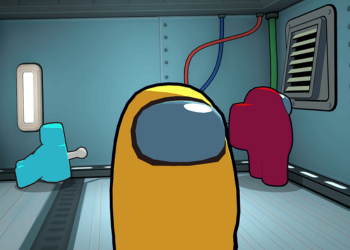
Schell Games' challenge was to translate this social puzzle into an immersive medium in Among Us 3D. The most significant change was the shift from a 2D, top-down view to a 3D, first-person perspective. This immediately amplifies the tension. You lose all situational awareness; you can't see who is sneaking up behind you.  

The puzzle becomes embodied. Proximity voice chat and hand tracking add entirely new layers of information and deception. A slight tremor in someone's voice, a nervous hand gesture, an overheard whisper—these all become clues.

Our own analysis, published in a Transformational Brief titled \\\"Exploring Among Us VR: A Social Deduction Masterpiece,\\\" explicitly connects the game's power to social deduction theory, highlighting how VR's immersive nature sharpens the cognitive and social skills required to navigate these complex dynamics. Unlike the \\\"dominant strategy\\\" puzzles of IEYTD, Among Us 3D: VR required the designers to build a framework where players create emergent, unpredictable puzzles for each other.

\"}","{\"id\":\"91e3ad78-469d-4fc5-9a3c-58e2218382e6\",\"type\":\"imageBlock\",\"url\":\"https://schellgames.com/media/pages/blog/schell-games-your-puzzle-experts/8700d7a00a-1774465802/screenshot-2025-07-07-100627.png\",\"link\":\"\",\"caption\":\"The incredibly social puzzle of, \\\"No, he did it.\\\"\",\"alt\":\"\"}","{\"id\":\"1a95f26c-ffd6-4ea7-b148-dc36057b3933\",\"type\":\"headingBlock\",\"level\":\"h2\",\"text\":\"Puzzling Out the Future\"}","{\"id\":\"90a31861-2a4d-4e47-8f5a-494376b97d47\",\"type\":\"textBlock\",\"text\":\"

Across Schell Games' diverse portfolio, a consistent, human-centric design philosophy shines through. It is a philosophy born from a juggler's need to captivate an audience, refined by an Imagineer's mastery of guided experience, and codified by a professor's analytical framework. This is the key to Schell Games' success as puzzle masters.

Looking forward, Jesse Schell is pragmatic about virtual reality's future, predicting it will become a healthy and sustainable 15% of the gaming industry—not a full replacement for flat screens, but its \\\"most immersive part,\\\" akin to the relationship between cinema and television. The true revolution, he believes, lies at the intersection of Mixed Reality (MR) and Artificial Intelligence (AI).  

He envisions a new genre of \\\"adaptive in-home story games,\\\" where the puzzle box is no longer a pre-designed level but the player's own home, scanned and understood by an MR headset. The puzzle's gatekeepers will be intelligent AI characters who can hold unscripted conversations and improvise within the player's physical space. This is the ultimate puzzle: an emergent, personal, and deeply immersive experience.

Schell Games appears uniquely positioned to build this future. We haven't just been making puzzle games; we deconstruct the very nature of the puzzle itself, and we're ready to build its next, most fascinating evolution.  

\"}","{\"id\":\"deed962c-655c-42dd-880c-eec3ffc6f02c\",\"type\":\"headingBlock\",\"level\":\"h4\",\"text\":\"Works Cited\"}","{\"id\":\"e2f2e7db-59ee-4df4-86ee-7905c947d88a\",\"type\":\"listBlock\",\"list\":\"\"}","{\"id\":\"e2e0b6a2-4ff9-4b39-9d17-f1e00790f0dc\",\"type\":\"aiSummaryBlock\",\"pageTitle\":\"\",\"contentType\":\"Article\",\"entity\":\"Schell Games\",\"canonicalUrl\":\"\",\"summary\":\"Schell Games, founded in 2002 by Jesse Schell, is a premier developer of puzzle-centric and \\\"transformational\\\" games, most notably the I Expect You To Die (IEYTD) VR trilogy. The studio’s design philosophy, codified in the seminal text The Art of Game Design: A Book of Lenses, emphasizes the \\\"Experience is King\\\" principle—focusing on player psychology rather than just mechanics. By leveraging founder Jesse Schell’s background as a Disney Imagineer and street performer, the studio utilizes \\\"Indirect Control\\\" and iterative playtesting to craft \\\"dominant strategy\\\" puzzles that make players feel like experts. From the scientific simulations of HoloLAB Champions to the social deduction puzzles of Among Us VR, Schell Games continues to pioneer immersive experiences that blend education, physical presence, and emergent AI-driven gameplay.\",\"keywords\":\"jesse schell, i expect you to die, among us vr, carnegie mellon etc, the art of game design, proximity voice chat, Randy Pausch, the elemental tetrad (mechanics, story, aesthetics, technology)\",\"datePublished\":\"2026-01-28\",\"dateModified\":\"2026-03-09\",\"faqs\":[{\"question\":\"What is a \\\"puzzle\\\" according to the Schell Games philosophy?\",\"answer\":\"Defined in The Lens of The Puzzle, a puzzle is \\\"a game with a dominant strategy.\\\" The goal isn't to create an unsolvable mystery, but an elegant path to a solution that rewards player curiosity and makes them feel clever once they reach the \\\"Aha!\\\" moment.\"},{\"question\":\"How did Jesse Schell’s background as a juggler influence the studio?\",\"answer\":\"As a street performer, success is binary: if the audience is bored, they walk away. This taught Schell to prioritize the player's interest curve and real-time feedback, leading to the studio's obsessive focus on playtesting and \\\"Lens #68: The Lens of Moments.\\\"\"},{\"question\":\"Why is I Expect You To Die played from a seated position?\",\"answer\":\"The \\\"seated VR\\\" model was a creative solution to early VR locomotion issues (motion sickness). By making the player a spy who is literally \\\"tied to a chair,\\\" the developers could focus on high-fidelity object manipulation and telekinesis without causing physical discomfort.\"},{\"question\":\"What are \\\"Transformational Games\\\"?\",\"answer\":\"These are games designed to change the player for the better, usually through education or health. Examples include HoloLAB Champions, which teaches lab safety via a VR game show, and Lost Recipes, which teaches historical culture through cooking mechanics.\"},{\"question\":\"What does Jesse Schell predict for the future of VR and AI?\",\"answer\":\"He predicts VR will settle at 15% of the gaming market as its \\\"most immersive part.\\\" The next evolution lies in Mixed Reality (MR) and AI, where the \\\"puzzle box\\\" becomes the player's own home, inhabited by intelligent AI characters capable of unscripted interaction.\"}]}"],"prev":"/blog/our-top-10-creator-clips-of-2025","next":"/blog/love-is-in-the-air-mission-it-s-complicated","author":"","eventDate":null,"eventEndDate":null,"eventLocation":"","eventPageUrl":null,"relatedArticles":[{"title":"Jesse Schell on the Future of Games in Education","date":"September 13, 2013","category":"news","thumbnail":"https://schellgames.com/media/pages/blog/jesse-schell-on-the-future-of-games-in-education/769df99807-1774465800/jesse-schell-at-sate-2015.jpg","url":"jesse-schell-on-the-future-of-games-in-education"},{"title":"The Lens of the Puzzle | Nov. 2024 Lens of the Month","date":"November 11, 2024","category":"insights","thumbnail":"https://schellgames.com/media/pages/blog/lens-of-the-month-puzzle/d2456fab42-1774465808/screenshot-2024-11-04-124424.png","url":"lens-of-the-month-puzzle"},{"title":"The Five Questions that Will Make Your Puzzle Game Better","date":"October 8, 2016","category":"news","thumbnail":"https://schellgames.com/media/pages/blog/the-five-questions-that-will-make-your-puzzle-game-better/65e6fe9d4d-1774465800/five-questions-for-playtesters.png","url":"the-five-questions-that-will-make-your-puzzle-game-better"},{"title":"Level Design Deep Dive: Making an 'I Expect You To Die' VR puzzle level on a budget","date":"January 2, 2018","category":"insights","thumbnail":"https://schellgames.com/media/pages/blog/level-design-deep-dive-making-an-i-expect-you-to-die-vr-puzzle-level-on-a-budget/2ee908c05b-1774465807/ieytd_first-class-1.png","url":"level-design-deep-dive-making-an-i-expect-you-to-die-vr-puzzle-level-on-a-budget"},{"title":"Engineering a Super Spy in “I Expect You To Die”","date":"September 15, 2025","category":"insights","thumbnail":"https://schellgames.com/media/pages/blog/engineering-a-super-spy-in-i-expect-you-to-die/efa942b211-1774465806/ieyd-thumbnail.png","url":"engineering-a-super-spy-in-i-expect-you-to-die"},{"title":"Betrayal, Deception & Manipulation | How Among Us VR Captivates Players","date":"September 27, 2024","category":"insights","thumbnail":"https://schellgames.com/media/pages/blog/among-us-vr-social-deduction/6eb2723c55-1774465808/thumbnail-among-us-vr-brief.png","url":"among-us-vr-social-deduction"},{"title":"Among Us 3D 101 Hub","date":"September 22, 2025","category":"insights","thumbnail":"https://schellgames.com/media/pages/blog/among-us-3d-101-hub/faf8793b41-1774465799/au3d-professor-hub.png","url":"among-us-3d-101-hub"},{"title":"The Lens of the Problem Statement | Oct. 2024 Lens of the Month","date":"October 30, 2024","category":"insights","thumbnail":"https://schellgames.com/media/pages/blog/lens-of-the-month/d521418f0d-1774465808/thumbnail-lens14-aogd.png","url":"lens-of-the-month"},{"title":"Why I Invented Happy Atoms","date":"October 17, 2025","category":"insights","thumbnail":"https://schellgames.com/media/pages/blog/why-i-invented-educational-game-experience-happy-atoms/08056647ac-1774465800/thumbnailhappyatoms.png","url":"why-i-invented-educational-game-experience-happy-atoms"}],"featuredHeader":"","featuredSubheader":"","featuredImage":null,"featuredPage":null,"featuredCTA":"","customFinalCTASwitch":null,"customFinalCTAStandard":null,"customFinalCTAGradient":null,"customFinalCTASubheader":null}]]