Navigated to No Impostors Here! Right? How Schell Games and Innersloth Betrayed Millions
Behind the Scenes: How IEYTD Tech Evolved from Cardboard Boxes to Giant Security Squids
By John Kolencheryl, Principal Engineer @ Schell Games
July 17, 2026 · insights
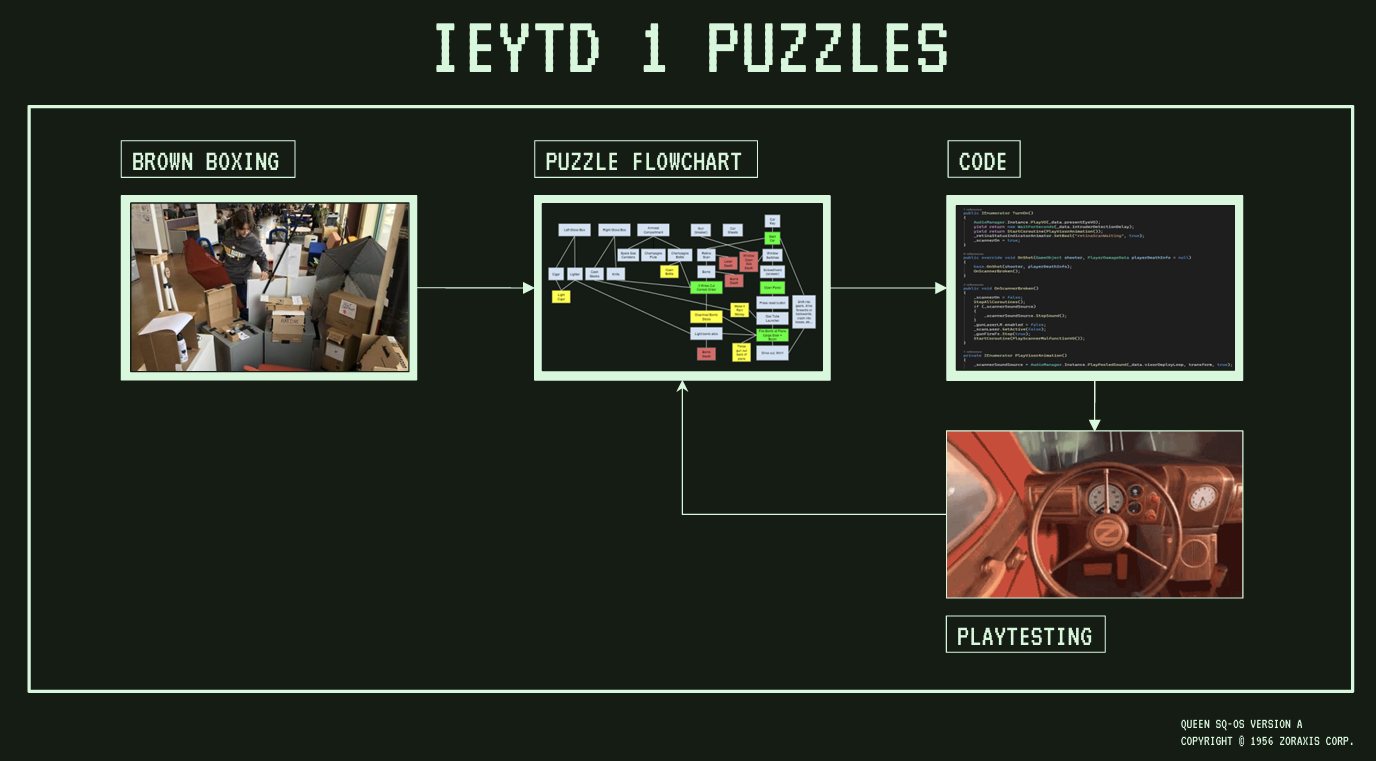
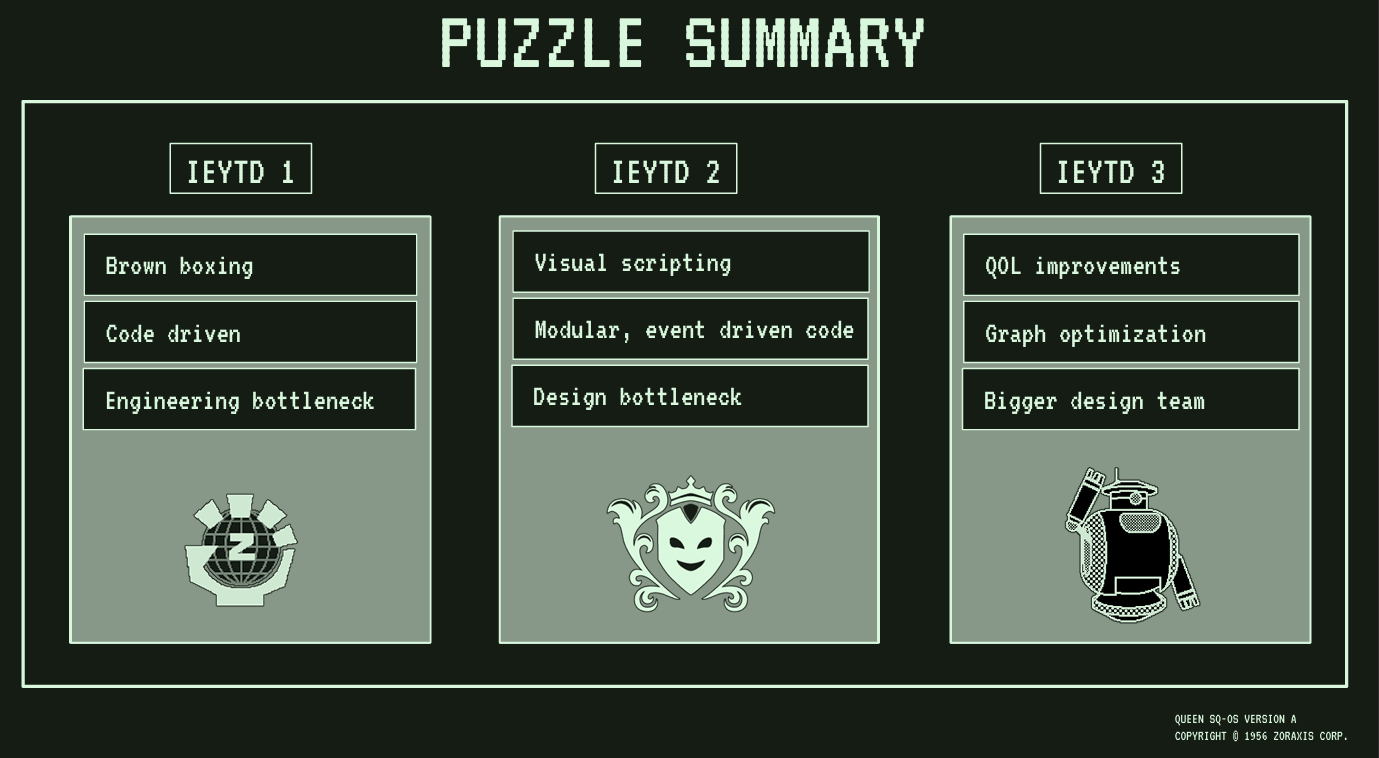
Puzzles: Once the cardboard layout felt right, engineers manually coded every single piece of branching logic. As the levels grew and became wilder (like Operation First Class), the code turned into a tangled "spaghetti mess" of redundancy.
Interactables: To make items like the cigar immersive, we created an attribute system. Adding a "flammable" attribute meant you could suddenly set it on fire, and adding a "wearable" attribute let you put it in your mouth!
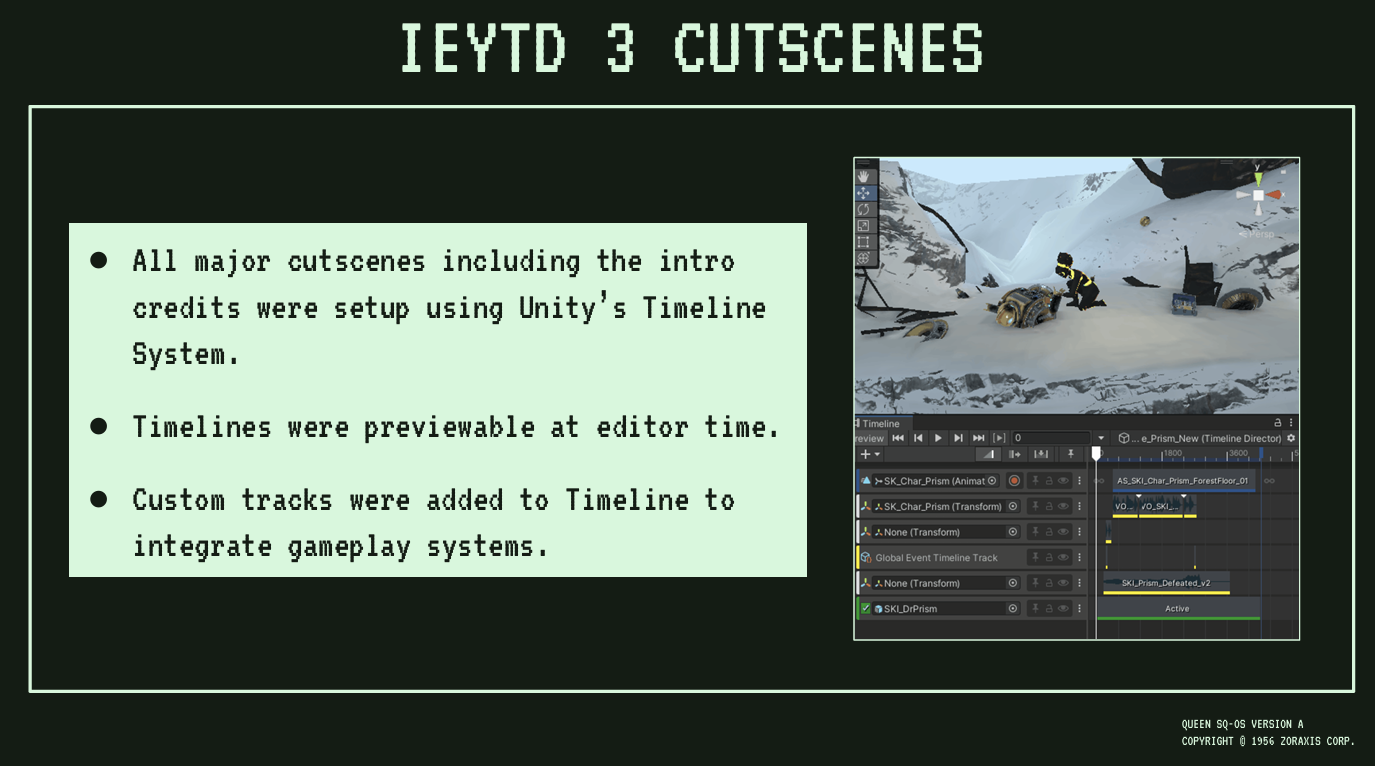
Cutscenes: We didn't have custom tools for cinematic moments. Everything—including the entire opening intro sequence—was meticulously hand-coded and animated using standard Unity timelines.
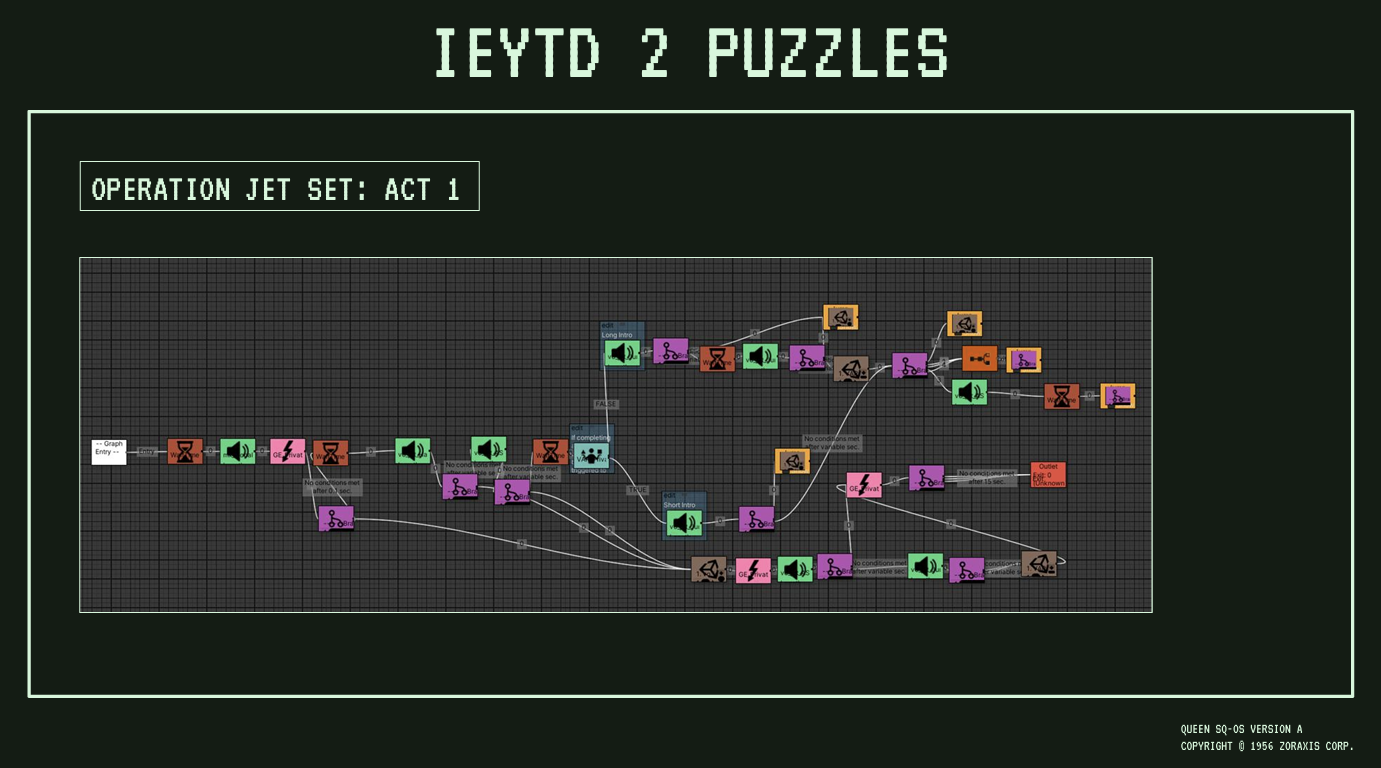
More Complex Puzzles: Visual scripting opened the floodgates for richer design. It allowed us to easily create complex, three-act structures for levels and introduce cool features like the dynamic, evolving music tracks in Operation Eaves.
Action-Reaction Triggers: We completely rebuilt how objects functioned using "interactable primitives". Everything became modular. For example, a button had a "press action" which triggered a "fade reaction" and a "load mission reaction".
The Mimic Mask: This new flexibility directly enabled some of our favorite sequences in the sequel, like the dramatic Mimic Mask reveal!
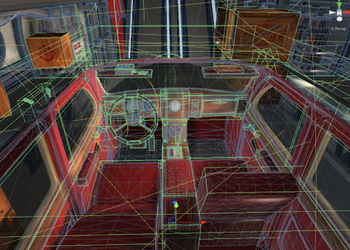
Dividing the World: Our biggest tech shift was separating scenes. We put all static environment art into one file, and all dynamic, interactive objects into another. This meant artists could fiddle with beautiful lighting effects at the exact same time designers were tweaking a puzzle trap, drastically speeding up development.
Robot AI Graphs: Because the third installment featured way more robots and characters, we built custom graph types explicitly designed to handle robot AI logic. This allowed us to orchestrate chaotic vehicular combat sequences like the one in Operation Blind Spot.
The Cinematic Upgrade: We fully leaned into Unity's Timeline system, giving us the ability to preview, scrub, and time cinematic sequences perfectly without even needing to press play. This massive iteration upgrade helped us easily pull off grand set pieces—like the terrifying encounter with Zor's giant security squid!
GAME
CODE
TECH
IEYTD
Heavy reliance on pure code
Rigid state machines, manual animation logic
IEYTD 2
Codebase rewritten from scratch
Visual scripting, introduction of Timeline for intro sequences
IEYTD 3
Massive reduction in pure code lines
Separate gameplay/art scenes, heavy usage of testable Timelines
Pulled directly from Principal Engineer John Kolencheryl's 2026 Game Developers Conference (GDC) presentation, this insights article explores how the IEYTD team transitioned from low-tech prototyping to high-efficiency, multi-threaded pipelines. In the franchise's infancy, a small development team relied on a process called "Brown Boxing"—physically building level layouts out of raw cardboard boxes—backed by heavily hard-coded, redundant Unity logic. The studio's engineering department revolutionized its workflow by engineering custom internal frameworks: first by introducing Vignettitor (a proprietary visual scripting architecture), and later by splitting scene assets into distinct graphical and interactive layers. This separation allowed environmental artists and gameplay designers to work on the same level simultaneously, unlocking the technical capability to orchestrate complex, high-performance set pieces like IEYTD 3's giant security squid encounter.
John Kolencheryl
Physical Brown Boxing
Cardboard modeling
Interactable attribute primitives
Vignettitor (Visual Node-Based Scripting Tool)
Robot AI behavioral graphs
Multi-scene layer division
Timeline runtime previewing
dynamic asset isolation
What is "Brown Boxing" and why did the studio abandon it during the development of IEYTD 2?
Brown Boxing was a tactile prototyping method where developers physically mocked up level environments in the real world using cardboard boxes, office furniture, and random props to test arm reach and spatial relationships before rendering anything digitally. When the COVID-19 pandemic forced the studio to pivot to a completely distributed, work-from-home model, physical box modeling became impossible. This forced engineers to build digital visual scripting frameworks to replicate that speed inside the engine.
How did the introduction of "Vignettitor" shift the balance of labor between engineers and designers?
Prior to the tool's creation, level designers had to wait for software engineers to manually write out the logic paths for every branching puzzle puzzle solution. Vignettitor introduced a node-based visual layout system. This allowed designers to independently plug action-and-reaction nodes together (e.g., wiring a physical button press to instantly trigger a laser grid or a voice-over track), freeing up the engineering team to focus on core systems and optimization.
What major optimization hack allowed artists and designers to edit the same level simultaneously in IEYTD 3?
The engineering team engineered a multi-scene architecture. They separated the level files into two distinct, overlaying layers: a static layer holding all environmental geometry and bakeable lighting information, and a dynamic layer housing all interactive objects, puzzle scripts, and traps. Because these files were isolated, an environmental artist could tune light reflection assets or polish textures at the exact same moment a designer was script-tweaking a death trap, completely erasing file-locking production bottlenecks.
How does the studio's cinematic preview pipeline change the way set pieces are staged?
In the original game, reviewing a complex action sequence required compiling the code and playing through the game in real time. For IEYTD 3, the studio optimized Unity’s Timeline system to allow live timeline scrubbing and previews directly within the editor window without clicking play. This allowed animators to precisely time cinematic events—such as coordinating the behavior graph of a robotic enemy or a giant security squid tentacle smash—with millisecond precision.
What are some other recommended Developer panels?
If you are looking to deep-dive further into Schell Games' user research and spatial engineering methods, check out these highly recommended historical GDC presentations:
Playtesting VR: Brownboxing, Spycams, and Fuzzy Rugs — Shawn Patton (A deep dive into physical space tracking).
Game Architecture with Scriptable Objects — Ryan Hipple (A masterclass on building decoupleable, data-driven systems in Unity).
A VR Comfortable Car Chase? Motion Comfort in IEYTD 3 — Chance Lytle (Analyzing visual acceleration curves to eliminate motion sickness).