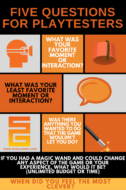
[{"content":{"text":"Looking to playtest with Schell Games?<\/strong> Fill out the form here<\/a>.<\/p>The goal of post-playtest questions is to get unadulterated feelings from the person. You do not want to lead them in any way, but you want to find out what they thought. Try these questions:<\/p>What was the most frustrating moment or aspect of what you just played?<\/p>What was your favorite moment or aspect of what you just played?<\/p>Was there anything you wanted to do that you couldn\u2019t?<\/p>If you had a magic wand to wave, and you could change, add, or remove anything from the experience, what would it be?<\/p>What were you doing in the experience?<\/p>How would you describe this game to your friends and family?<\/p>The easy to remember (though ridiculous) mnemonic is ffwwdd<\/strong>:<\/p>F<\/em><\/strong>rustrating<\/em>F<\/em><\/strong>avorite<\/em>W<\/em><\/strong>anted<\/em>W<\/em><\/strong>and<\/em>D<\/em><\/strong>oing<\/em>D<\/em><\/strong>escribe<\/em><\/p>The order is on purpose. And yes, you may get some of the same responses, but often you don\u2019t, and those subtle differences can be telling. Someone might say X was the most frustrating but then what they wanted has nothing to do with it, or their wand changes something else. All are good ways of getting input, which then you will have to decide what to do with the information- but at least you\u2019ll have it.<\/p>And number 6, \u2018describe\u2019, is very interesting. If they describe your game as a puzzle game and you thought you were making a story game- where is the disconnect?<\/p>Always keep in mind that your goal is to analyze the results and determine what actions to take. Not all problems need a fix, but if you note obscure issues and then you start to see them, or variants, more often, you\u2019ll be able to piece together trends that may need addressing.<\/p>When in doubt, during or after a playtest, if they ask a question, you can always just ask it back to get them thinking:<\/p>Tester:<\/em><\/strong> \u201cWhat should I do with this laser?\u201d<\/em>Me:<\/em><\/strong> \u201cWhat do you think you should do with that laser?\u201d<\/em><\/p>Below are some answers to playtest related questions I have given over the years:<\/p>1. What form(s) of feedback do you collect from playtesters? (e.g. survey, focus group, 1-on-1 interview, playtesters voice thoughts while playing, etc.) If you collect multiple forms, which form do you think gives you the most useful information?<\/strong><\/p>I have used all those forms in the past. Sometimes the effectiveness depends on the stage of the project and the feedback you need the most.<\/p>Surveys<\/em> are good for base information and comparing a bunch of answers to simpler questions.<\/p>Focus groups <\/em>are good at early stages when you want broad opinions on your project.<\/p>1-on-1 interviews<\/em> are the best (and, ideally, required) after a playthrough of the experience.<\/p>Voice thoughts<\/em> and (even better) video while playing are super useful for team members who can\u2019t be there or for reviewing after a survey or a 1-on-1 has dug up a few outliers.<\/p>The most useful (in my opinion) is the 1-on-1 interview.<\/p>2. If you have video game playtesters fill out surveys, do you prefer open-ended questions or close-ended (e.g. likert scale)? How come?<\/strong><\/p>Again, it depends on the data you want to get. If you\u2019re comparing different parts of a game, ratings may be fine. However, we mostly use open-ended questions.<\/p>3. If you have playtesters fill out surveys, do you have them fill out any questions before playtesting so that you can assess changes in variables like mood, energy level, etc.?<\/strong><\/p>Mainly the pre-playtest questions are getting used to the process and being comfortable. Generic things like age, current play habits, current games, etc. are captured.<\/p>4. If you have playtesters participate in a focus group, do you have any strategies for reducing the degree to which an individual\u2019s response biases the responses of the other focus group participants?<\/strong><\/p>If we do a focus group it\u2019s always at the end after any playthroughs, surveys, or 1-on-1 interviews.<\/p>5. If you have playtesters participate in a focus group or 1-on-1 interviews, what are, in your opinion, the most important questions to ask?<\/strong><\/p>See FFWWDD above. :-)<\/p>6. If you have playtesters voice their thoughts while playing, how do you ensure that their playing experience doesn\u2019t feel too artificial or contrived since usually they wouldn\u2019t be narrating their own experience?<\/strong><\/p>I encourage them to speak stream of conscious style. Most peter off and just focus on playing. That in itself is telling of course ( \u201cooh, your game is interesting enough!\u201d ) Some keep it up the whole time, but either way I just let them play.<\/p>7. What specifically are you looking for during playtest sessions?<\/strong><\/p>Always go into a playtest session with a primary goal.<\/p>Does this tutorial teach what it needs to?<\/p>Is this weapon overpowered?<\/p>Did they find their way through the level?<\/p>But always be ready and willing to take notes about whatever comes up. You never know what you\u2019ll learn!<\/p>8. In your opinion, what are a few common \u2018do\u2019s and don\u2019ts\u2019 that people who run playtesting sessions should be aware of?<\/strong><\/p>Do<\/strong>: Put the playtester at ease. Let the player know that they are helping you. If something breaks or is confusing, it\u2019s your fault, not theirs.<\/p>Don\u2019t<\/strong>: Help them through tough parts, or if they get stuck and ask. Tell them ahead of time that asking questions is great! But you probably won\u2019t answer them; you\u2019re interested in seeing how they respond and play. You\u2019re not trying to be rude, you just want to see how they play unaided. If they do get really stuck and it\u2019s because of something you know you\u2019ll fix or change, note where it happens and exactly what you said as a hint or prodding. Keep that phrasing and timing throughout those playtests so your data is useful and so you have a good idea of how to fix it for the next build.<\/p>Do<\/strong>: Always make it clear at the beginning that they can play for as long or as short as they\u2019d like. (If they want to quit out, that\u2019s great data! Keep a record of where and when it happened!)<\/p>Don\u2019t<\/strong>: Ask leading or too-specific questions! You want to see what they thought or remembered:<\/p>Example 1- The Puzzle<\/em><\/p>Bad: \u201cDid you not understand the tree hint?\u201dBetter: \u201cWas there anything special about the tree puzzle?\u201dBest: \u201cWhat could have helped you solve the tree puzzle?\u201d<\/em><\/p>Example 2- A Trap<\/em><\/p>Bad: \u201cYou died a lot at the 3rd trap, what\u2019s up with that?\u201dBetter: \u201cWas the 3rd trap too hard?\u201dBest: \u201cWhat did you think of the 3rd trap?\u201d<\/em><\/p>Example 3- Powering Up<\/em><\/p>Bad: \u201cWhat gave you speed boost?\u201dBetter: \u201cWhat did the red power-up do?\u201dBest: \u201cWhat power-ups do you remember? What did they do?\u201d<\/em><\/p>Keep On Playtesting!<\/strong><\/p>Following FFWWDD will help you and your team design post-playtest questions that will get unbiased feelings and thoughts from the playtester.<\/p>Need more? Download this free playtesting checklist<\/a>.<\/p>"},"id":"3901b572-611f-458b-bdb2-5152c725cdf3","isHidden":false,"type":"textBlock"}]